
Yes, you can rebuild a WordPress website with AI — paste your URL and it comes back as an editable site — and from there Outlyne works as your conversion coach, suggesting changes that turn more visitors into inquiries and making them for you once you give the go-ahead. This works best for the marketing side of a WordPress site, so this guide covers what actually carries your Google rankings, which WordPress pieces do not come with you, and how to make the switch without losing the traffic you already have.
Can you rebuild a WordPress website with AI?
Yes. You do not need to export a database, touch PHP, or spin up a staging host. Outlyne rebuilds from your live site: paste your WordPress URL and it loads your pages the same way a visitor’s browser does, reads your text and layout, and rebuilds them as a new, editable site, starting with the page you pasted, usually your home page, with each of the others ready to build when you open it.
Why you do not need a WordPress export
Unlike the closed site builders, WordPress genuinely lets you take your data out: the built-in export tool downloads your posts and pages as a WXR file, and a self-hosted site can be copied whole, files and database, to a new host. What each of those gets you, though, is another WordPress install. The WXR file is content data without your theme, plugins, or layout, and a full copy brings the whole maintenance stack along with it. The Outlyne importer takes a different path. It reads your published pages the way Google does, so nothing has to be exported first, and it works the same whether you are on WordPress.com or a self-hosted site, since from the outside both are just a live website. Your site does need to be live and reachable.
It rebuilds, it does not migrate your install
The thing to understand up front is that this is a rebuild, not a migration of your WordPress install. The AI is not carrying over your theme, your plugins, or your wp-admin; it is recreating your content as fresh, structured sections. That is what ends the upkeep, and it is why the SEO steps below matter: you are moving your content off the old stack, so you want to bring the load-bearing parts with it.
If your pages are built with a page builder like Elementor or Divi, they lean on a lot of generated markup and scripts. The importer reads the rendered page, so what it captures is what a visitor actually sees, not the builder’s scaffolding.
Why do people move their website off WordPress?
The reason is almost always the upkeep.
The maintenance never stops
WordPress is powerful, but a self-hosted site turns into a standing chore: plugin and core updates, security patches, theme conflicts, backups, hosting bills, and a page that slowly gets heavier. WordPress.com takes the hosting and patching off your plate, but the editing model is the same — you still work through a theme, a block editor, and plugins to change a page. When a simple copy change means opening the editor, dodging a plugin, or calling a developer, people start looking for a way out.
The stack fights simple changes
Between the theme, the page builder, and a stack of plugins, even small edits can mean navigating three layers to change one line. Describing the change and having it happen is the specific pull toward AI tools.
When not to move
None of this is a reason to move if your current site is working and the upkeep does not bother you. Moving is worth it when that maintenance is the tax you are trying to escape, and when your site is mostly marketing pages rather than a plugin-driven application. If your WordPress site is really a store or a members app, weigh that part separately before you switch.
Should you move from WordPress to Outlyne, or stay?
The honest answer is that it depends on how much of your WordPress site is content and how much is plugin-driven functionality. Outlyne is built for the marketing side, the pages people read, and it rebuilds those well. It is not yet the right home for a site whose core is a store, a course, or a members area.
| Outlyne is a good fit when | Stay on WordPress, for now, if |
|---|---|
| Your site is mainly marketing and lead generation | You run a store on WooCommerce |
| You want to drop the plugin-and-hosting upkeep | You run a membership or course site |
| You want editing without a theme or page builder | You depend on directory or other app plugins |
| You are happy to rebuild rather than copy every detail | Your site is really a plugin-driven app |
Outlyne rebuilds the marketing pages well, but it does not run plugins, ecommerce, or memberships yet. If those are the heart of your site, keep them on WordPress or hold off. Bookings are different: Outlyne has booking built in to take over from a booking plugin, and a scheduler embedded from a service such as Calendly or Acuity comes across, with the importer telling you if it can’t. A form built with Gravity Forms or another form plugin is rebuilt as a working Outlyne form with the old form’s fields, though the plugin’s own features, such as conditional logic or payments, are not. If your WordPress site is mostly pages, it is a strong fit.
Use the move to trim, not just copy
Even when Outlyne is a clear fit, do not recreate every page just because it exists. A migration is a chance to simplify: keep the pages that earn traffic or drive inquiries, and drop the duplicate landing pages, the abandoned blog posts, and the sections nobody reads. A leaner site is easier to keep good.
What happens to your SEO when you rebuild a website?
Your rankings do not belong to WordPress or to your SEO plugin. They sit in a few things you carry across when you rebuild.
The five things that carry your rankings
- Your URLs. Google ranks specific pages at specific permalinks. WordPress uses a few patterns, from
/post-name/to dated ones like/2024/05/post-name/. Keep the same paths. - Your content. The words on each page are most of what you rank for. Bring the meaningful text across; do not thin it out for a cleaner design.
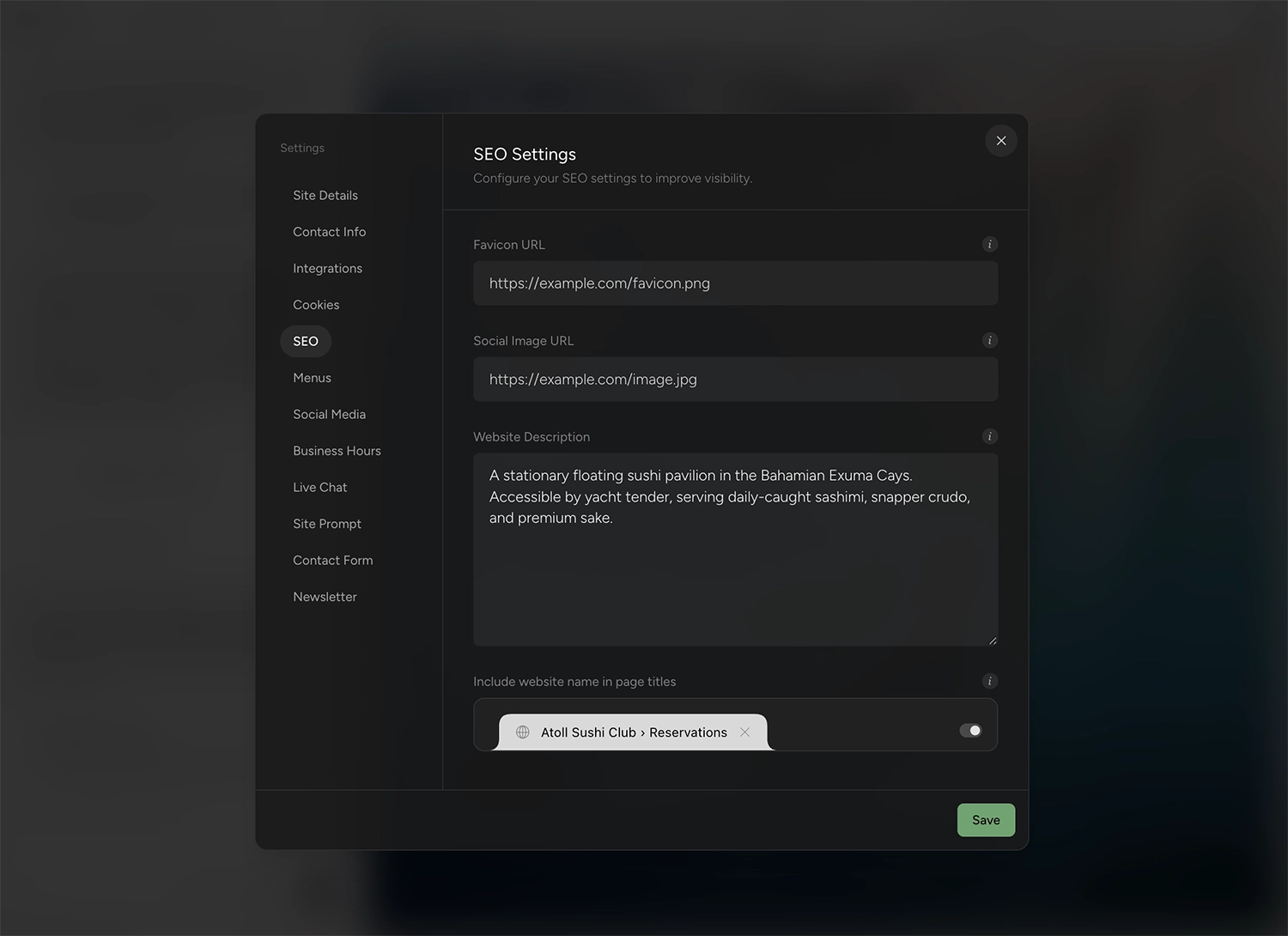
- Your titles and descriptions. The SEO titles and meta descriptions Yoast or Rank Math has been managing for you.
- Your headings. One clear H1 per page and sensible H2s, so Google and AI answer engines can read the page.
- Your internal links. The links between your own pages that move authority around the site.
Rankings follow content and links, not the CMS underneath them. Move those across intact and your positions come with them.
The WordPress-specific things to watch
Your SEO plugin has been doing more than you might notice: managing titles, meta descriptions, and the sitemap. All of that value is in the content itself, not the plugin, so it carries as long as you bring it. Before you switch, note your permalink structure exactly, since dated and category-prefixed permalinks are easy to get wrong on the new site.
The one mistake that tanks traffic
Keep those and your rankings have no reason to fall. Redesigns tank traffic when one of them breaks, and on WordPress the classic mistake is changing the permalink structure so the paths no longer match, which orphans every old link at once.
How does Outlyne rebuild your WordPress site?
You paste your WordPress URL, Outlyne reads the live site, and it rebuilds the page you pasted, usually your home page, as a set of named sections: a hero, a features block, testimonials, a services list, a contact section, and so on. You can edit it as soon as it is done, and each of the other pages Outlyne read waits in your page menu, ready to build when you open it.
From live pages to named sections
The import reads the rendered page, so whether your site runs a classic theme or a page builder, what it captures is the finished result a visitor sees, rebuilt to match your structure.
Why typed sections beat vibe-coded sites
The other AI route off WordPress is a vibe-coding tool, an AI that creates your site as code. Tools that generate raw code hand you a one-off pile of markup, which is just a new thing to maintain in place of the theme you were trying to leave. Outlyne rebuilds your site into real, typed sections the system understands. Because it knows a hero is a hero and a testimonial is a testimonial, editing stays a normal act, styling stays consistent across every page, and an improvement to a section type rolls out everywhere it is used. And instead of a theme, the look of the site is a design system built custom for it — colors, type, and spacing you have full control over — so a restyle is a system change, not a theme swap. You trade the plugin-and-theme stack for structured content, not for another codebase.
How do you keep your SEO when leaving WordPress?
Work through this in three phases: before you switch, during the rebuild, and after you go live.
Before you switch
- Inventory your URLs. Write down every page that gets search traffic. Your sitemap gives you the full list fast: Yoast publishes it at
/sitemap_index.xml, and WordPress core serves/wp-sitemap.xmlwhen no SEO plugin has taken it over. The Pages report in Google Search Console then shows which of those pages actually earn clicks. - Note your permalink structure, titles, and descriptions. Record the exact permalink pattern and copy the title and description Yoast or Rank Math set for each page you are keeping.
During the rebuild
- Match your paths, or redirect them. Name your new pages so their URLs match your old ones exactly, since matching your paths is what carries the rankings across. Where a path has to change, add a permanent (301) redirect from the old URL to the new one in Outlyne’s site settings, which handles temporary (302) redirects too; a 301 tells Google the page has moved for good, so its ranking follows.
- Preserve headings and content. Keep one H1 per page and the body text that earns your rankings. Rewriting is fine; deleting sections to tidy the design is how traffic drops.
- Carry over titles and descriptions. Match each page to what your SEO plugin had, unless you are deliberately improving it.
After you go live
- Point your domain and confirm your paths. Build every page you need first, since a page that is not built yet stays off the published site. Once the new site is live on your domain, spot-check that your important pages sit at the URLs you matched, and that each old URL you redirected lands on its new page.
- Resubmit your sitemap. Submit the new sitemap in Google Search Console so it recrawls quickly, then watch the Pages report over the next couple of weeks to confirm your key pages stay indexed.
See the custom domain guide for the DNS steps.
How long does it take to rebuild a WordPress site with AI?
The import itself is quick, and for a marketing site of a handful of pages you can be looking at a near-complete draft the same afternoon.
The import is fast
You can look at and edit the page you paste within minutes, rather than waiting on a migration to finish in the background. Every other page the import read is already in your page menu, and you build each one when you open it, which takes a free Outlyne account and some of its AI credits.
The polish is the real work
The draft is the start, not the finish. Plan on an afternoon working through it with the Outlyne AI: checking every page, tightening copy, swapping images, having it coach each page toward more inquiries, and getting its advice as you run the SEO checklist above.
It depends on how much is content versus plugin
The timeline really turns on how much of your WordPress site is content and how much is plugin functionality. A brochure site is an afternoon. A site with a store or a large blog needs a plan for those parts on top of the rebuild. Either way, each page the import reads takes a single click to rebuild, and the plugin parts are what you plan for. The whole move is still far faster than a from-scratch WordPress redesign.
A single import reads up to ten pages of your site, starting from the URL you paste, and pages beyond that are ones you add in Outlyne afterward, by hand or with its AI.
What won’t transfer automatically from WordPress?
Some things come across cleanly and some do not, and on WordPress the line matters more than on most platforms, because so much of a WordPress site can be plugin functionality rather than content.
What comes across well
Your text, your page structure, and your general layout, which is the whole of a typical marketing or brochure site. Your images are copied into your Outlyne site as each page is built, so they no longer load from your old host. An image the copy can’t fetch keeps loading from the old site, so if one goes missing after you take that site down, re-upload it.
What you will rebuild separately
- Plugins and their functionality. WooCommerce stores, membership and course platforms, and booking plugins are applications, not page content, so plan to keep or replace them separately. Outlyne has booking built in to take over from a booking plugin.
- Your theme and custom code. Custom PHP, theme templates, and shortcodes are WordPress-specific and do not follow.
- Dynamic archives and custom post types. Large auto-generated blog archives and custom post type listings are generated by WordPress, so decide which of those you actually need to recreate.
- Forms. The rebuild recreates your contact and lead forms, Gravity Forms and Contact Form 7 included, as working Outlyne forms with the old forms’ fields, and a form embedded from a form service, such as Jotform or Typeform, comes across still connected to it. A form plugin’s own features, such as conditional logic or payments, do not come with it. Most newsletter signups become Outlyne newsletter signups, so new subscribers collect in Outlyne rather than in the list they fed. Export your list before you switch. The importer tells you about other things it couldn’t keep, such as a file upload or a signup from Mailchimp’s embed code that will no longer reach its list, and what is left is checking the address the rebuilt forms email their submissions to.
None of this blocks a move for a content-driven site; it is the list that tells you whether your WordPress site is mostly pages or mostly app.
How do you point your domain at the new site?
You point your domain at the new site by updating its DNS, and because your domain usually lives at a registrar separate from your WordPress host, this does not disturb the old site until you are ready.
Your domain is probably already separate
Most self-hosted WordPress domains sit at a registrar like Namecheap, GoDaddy, or Cloudflare rather than at the host, so moving off WordPress does not touch ownership. A domain you registered through WordPress.com is yours too: you manage its DNS from your WordPress.com account, and you can transfer the registration to another registrar later. Either way, confirm you can sign in wherever the DNS settings live before you switch.
Making the change
The short version is that you add a record at your DNS provider pointing your domain to your Outlyne site, then add the domain in Outlyne. You can keep WordPress running until the new site is verified, then flip the DNS, so there is no gap where your site is down.
Do not break your email
One gotcha catches people. If you run email on your domain, such as Google Workspace or Microsoft 365, your mail is routed by separate MX records. Leave those untouched when you update your DNS, or you can knock your email offline while chasing the website change. Change only the records that point the website.
The full walkthrough, including the exact record values, is in the custom domain guide.
So, is Outlyne right for your WordPress site?
Here is the short version. Outlyne is a good replacement when your WordPress site is mainly marketing pages you are tired of maintaining: pages that explain what you do and bring in inquiries. That is the job Outlyne’s AI is built for. It knows the strategies that make a site convert, whether the goal is captured leads, booked tables, or newsletter signups, and it will point at what to change on your pages and, with your go-ahead, make the changes for you. It is not the right move if your site runs on WooCommerce or a membership or course platform, since those are not part of Outlyne yet.
A low-risk way to decide
You do not have to commit to find out. Paste your WordPress URL into Outlyne and rebuild a single page before you change anything on WordPress. You get a real look at the result and the editing experience while your existing site stays live and untouched. If it fits, you carry on; if it does not, you have lost nothing.
When you are ready to move the whole site, work through the URL-matching and domain steps above so your rankings come with you.
Frequently asked questions
- Do you need to export your WordPress site first?
- No. WordPress, to its credit, does let you take your data out: the built-in export tool downloads your posts and pages as a WXR file, and a self-hosted site can be copied whole to another host. But both of those get you another WordPress install, not an editable site elsewhere, and neither is needed here anyway. Outlyne’s AI reads your live pages the way a visitor or Google does.
- Will my Google rankings drop if I move off WordPress?
- They won’t drop as long as the pages Google already ranks you for keep the same URLs. WordPress sites often credit their rankings to an SEO plugin like Yoast or Rank Math, but the ranking value lives in the content and links those plugins manage, not in the plugin itself. Keep the paths, the copy, and the titles and your positions come with you.
- Can I keep my domain when I leave WordPress?
- Yes. On a self-hosted site your domain lives at a registrar, usually separate from your WordPress host, so moving does not touch ownership. A domain registered through WordPress.com is also still yours: you manage its DNS from your WordPress.com account and can transfer it to another registrar later. Either way, you point the domain at the new site by updating its DNS; confirm you can sign in wherever those DNS settings live before you switch.
- Can Outlyne rebuild a WooCommerce store or membership site?
- No, and that is the dividing line to check before you move. Outlyne rebuilds the marketing side of a WordPress site, the pages people read. A store on WooCommerce or a membership or course area is a plugin-driven app, not page content, so plan to keep or replace those parts separately rather than expecting them to rebuild. Bookings are different: Outlyne has booking built in to take over from a booking plugin, and a scheduler embedded from a service such as Calendly or Acuity comes across, since the importer brings it and tells you if it can’t.
- Is the rebuilt site still editable afterward?
- Yes. The rebuilt site is made of real, named sections you edit in the app rather than generated code, so there is no theme to wrangle, no plugin to update, and no PHP to touch when you want to change a headline.
- How much does Outlyne cost compared to WordPress?
- There is no single WordPress price to compare. The software is free; on a self-hosted site the real cost is hosting, premium plugins and themes, and the time or developer you pay to keep it patched, while WordPress.com’s plans run from $4 a month for Personal to $45 a month for Commerce in the first year, billed annually, and renew at $8 to $62 a month after that. Outlyne Pro is $15 a month billed annually, or $20 month to month, and the free tier lets you rebuild your site and try the editor before paying anything. The fair comparison is total upkeep, not the license: the Outlyne subscription covers hosting and an AI that coaches your pages toward more inquiries, builds you a custom design system you have full control over, and supports full website export, so your site and your data stay yours.
- Should I move my WordPress site to Outlyne, or stay on WordPress?
- Move it if the site is mainly marketing pages you want to stop maintaining: pages that explain what you do and bring in inquiries, and you want an AI that coaches those pages toward more of them. Stay on WordPress if your site runs on WooCommerce or a membership or course platform, since Outlyne does not have those yet. Bookings are no reason to stay: Outlyne has booking built in to take over from a booking plugin. A good way to decide is to rebuild one page in Outlyne before changing anything on WordPress.