

Yes, you can rebuild a Google Sites website with AI — paste your URL and it comes back as an editable site — and from there Outlyne works as your conversion coach, suggesting changes that turn more visitors into inquiries and making them for you once you give the go-ahead. Because Google Sites gives you so little SEO control — no meta descriptions, no sitemap, a title tag that is just the page name — the move is usually an upgrade rather than a risk, and this guide covers how it works, what improves, what does not transfer, and how to switch cleanly.
Can you rebuild a Google Sites website with AI?
Yes. You do not need to export anything, which is just as well, since the closest thing Google Sites has to an export is a backup: Google Takeout hands you a static snapshot of your pages as HTML files and images, not a working site. Outlyne rebuilds from your live site: paste your Google Sites URL and it loads your pages the way a visitor’s browser does, reads your text and layout, and rebuilds them as a new, editable site, your pages and sections streaming in as it works.
The export is a backup, not a way out
Google Sites keeps your pages inside Google. The Takeout snapshot is frozen the moment you download it, and the classic version of Sites, which had its own export tooling, stopped being viewable in January 2023, so every Google Sites site running today is the current version with the same limits. None of that matters here, because the AI does not read an export. It reads your published pages the way Google does, so whatever is live is readable, custom domain or sites.google.com address alike. The one requirement is that the site is published as Public: a site restricted to specific people or your organization is no more visible to the importer than it is to Google.
It rebuilds into a real website
The thing to understand is that this is a rebuild into a real website, not a copy of a Google Sites page. The AI recreates your content as fresh, structured sections you can actually design and edit, which is a real step up from Google Sites’ fixed layouts. It is also why the SEO steps below matter, though in this case most of them are improvements rather than things to protect.
Why do people move their website off Google Sites?
Google Sites is free and genuinely easy, which is why so many simple sites start there.
Basic by design
The catch is that it is basic on purpose: the layouts are rigid, the styling is limited, and the result tends to look like a Google Sites page rather than a business’s own site. Being able to describe the site you actually want, instead of arranging Google’s fixed blocks, is the pull toward AI.
It holds back your search visibility
Google Sites also gives you almost none of the controls that help a site get found. There is no meta description field, so search engines assemble your snippet from whatever text they find. Your title tag is simply your page name. Google Sites no longer generates an XML sitemap and gives you nowhere to add your own, or a robots.txt. And being hosted by Google does not make up for any of it: Google Sites pages get no ranking boost for being Google’s, so they compete under the same algorithm as everyone else, with fewer tools.
When Google Sites is fine
If the page is only ever an internal wiki, a class page, or a throwaway link, Google Sites is perfectly fine and not worth replacing. It is worth outgrowing when the page represents your business and needs to look the part and be found.
Should you move from Google Sites to Outlyne, or stay?
The honest answer is that for most Google Sites pages, moving is an upgrade rather than a risk, because Google Sites gives you so little design and SEO control. The main reason to stay is that the page is internal or throwaway.
| Outlyne is a good fit when | Stay on Google Sites when |
|---|---|
| Your page represents your business and needs to be found | The page is an internal wiki, class, or team page |
| You want a real design instead of a basic layout | It is a throwaway or temporary link |
| You want real control over titles and structure | It leans on embedded Google Docs, Sheets, or Forms |
| You are happy to rebuild it as a proper site | You need it to stay inside Google Workspace |
Google Sites has no built-in store or booking system, so there are few hard blockers. Embedded Google Workspace content, like Docs, Sheets, Forms, and Calendars, does not carry, so plan to recreate or re-embed it. If the page represents your business, moving almost always helps.
Use the move to trim, not just copy
Even when Outlyne is a clear fit, do not recreate every page just because it exists. A migration is a chance to simplify: keep the pages that earn traffic or drive inquiries, and drop the duplicate landing pages, the abandoned blog posts, and the sections nobody reads. A leaner site is easier to keep good.
What happens to your SEO when you rebuild a website?
Here is where Google Sites is different from most platforms: it gives you so little SEO control that moving usually improves your position rather than threatening it. Your rankings still live in the same handful of things, and now you can actually manage them.
The five things that carry your rankings, now yours to control
- Your URLs. Keep the paths you already have indexed.
- Your content. The words on each page are most of what you rank for. Bring the meaningful text across.
- Your titles and descriptions. Google Sites never let you set these — the title tag was your page name and there was no description field. On the new site you control them per page, which is often an immediate gain.
- Your headings. A clear H1 and sensible H2s become yours to set, instead of whatever heading tags Google Sites’ text styles happened to produce.
- Your internal links. The links between your pages that pass authority around.
On most moves you protect your SEO. Leaving Google Sites, you usually upgrade it.
Why leaving Google Sites usually helps
Because most Google Sites pages rank weakly for lack of these controls, giving each page a real title, a real description, and a proper heading structure often lifts it. Keep your content, keep your URLs the same, and the move should only help.
How does Outlyne rebuild your Google Sites site?
You paste your Google Sites URL, Outlyne reads the live site, and it rebuilds each page as a set of named sections: a hero, an about block, a services block, a contact section, and so on. You watch them land in the editor as it works.
From live pages to named sections
The import reads your rendered pages and rebuilds them to match your structure, turning a fixed Google Sites layout into sections you can genuinely design.
Why typed sections beat vibe-coded sites
The other AI route to a rebuild is a vibe-coding tool, an AI that creates your site as code. A tool that generates raw code hands you a one-off pile of markup: to change anything later, you or the AI has to edit that code, and it drifts. Outlyne rebuilds your site into real, typed sections the system understands, so editing stays a normal act, styling stays consistent across every page, and improvements to a section type roll out everywhere they are used. And instead of Google Sites’ fixed theme, the look of the site is a design system built custom for it — colors, type, and spacing you have full control over — so a restyle is a system change, not a page-by-page repaint. You go from a fixed Google Sites layout to a site you can genuinely shape, without a codebase to manage.
How do you set up SEO when leaving Google Sites?
Work through this in three phases: before you switch, during the rebuild, and after you go live. On a Google Sites move, most of this is setup you never had before, not damage control.
Before you switch
- Inventory your URLs. Write down every page you want to keep. Google Sites gives you no sitemap to read, so work from the Pages panel in the editor, and if you have Google Search Console connected, its Pages report shows which pages earn clicks.
- Gather your content. Note the text and images on each page so nothing is lost in the move.
During the rebuild
- Match your paths. Name your new pages so their URLs match your old ones exactly, since matching your paths is what carries the rankings across. Outlyne does not offer custom redirects yet, so a URL you cannot match is a ranking you cannot fully protect; prioritize matching your highest-traffic pages.
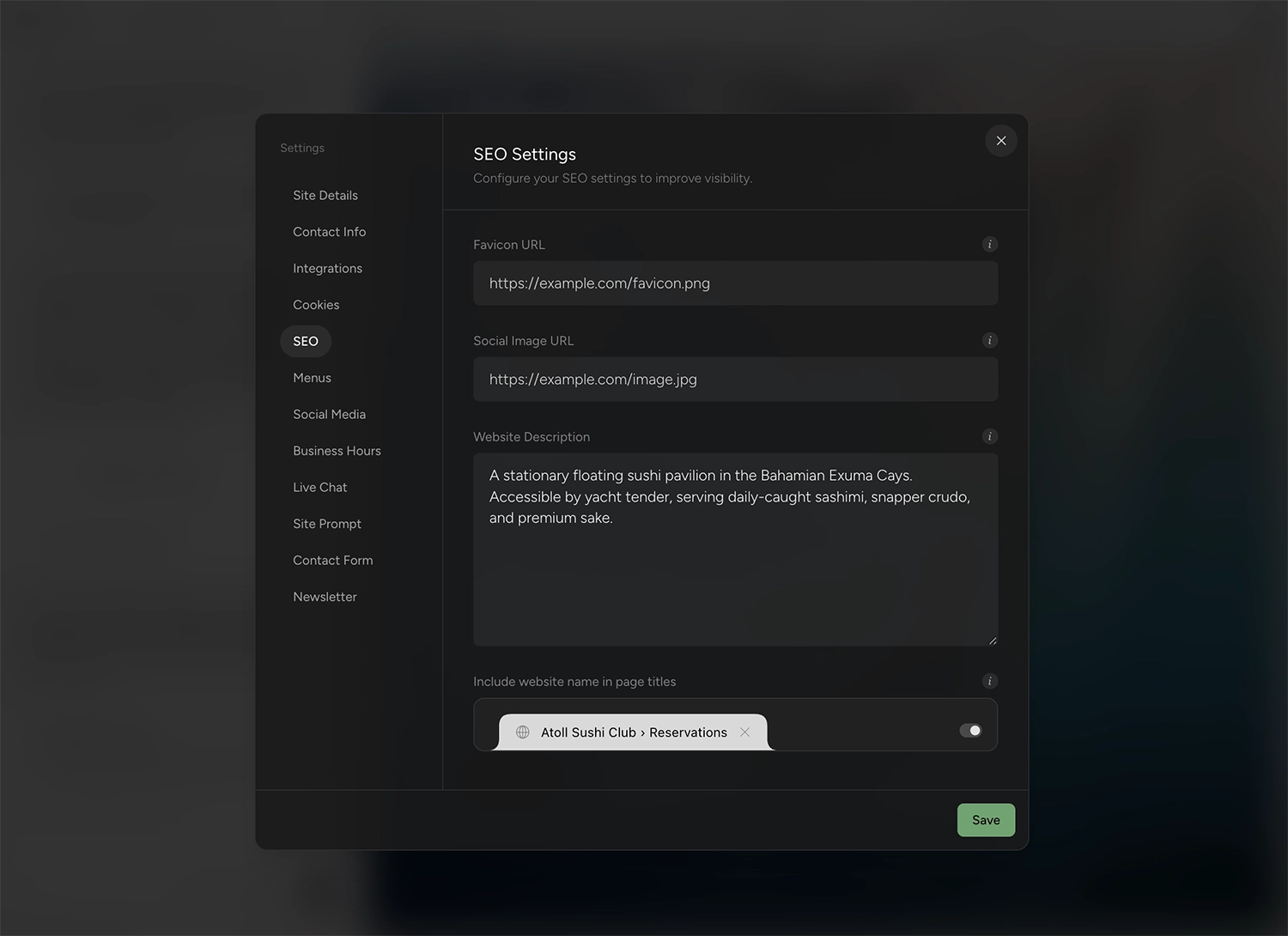
- Set titles and meta descriptions. This is the big upgrade: write a real title and description for each page, which Google Sites never let you do properly.
- Give each page one H1 and sensible H2s. Structure the headings so Google and AI answer engines can read the page.
After you go live
- Point your domain and confirm your paths. Once the new site is live on your domain, spot-check that your important pages sit at the URLs you matched.
- Submit your sitemap. Submit the new site’s sitemap in Google Search Console — the first sitemap your site has had, since Google Sites does not generate one — so your pages get crawled and indexed, then watch the Pages report to confirm they appear.
See the custom domain guide for the DNS steps.
How long does it take to rebuild a Google Sites site with AI?
The import itself is quick.
The import is fast
Pasting the URL and watching your pages rebuild takes minutes, and because Google Sites pages are usually small, you can often be looking at a near-complete draft in well under an afternoon.
Small sites finish quickly
Most Google Sites sites are a handful of simple pages, so there is not much to review, and the whole move often wraps up in a single sitting.
Treat it as a real site to shape
The draft is the start, not the finish, though for a simple Google Sites page the finish is not far off. Plan on a session with the Outlyne AI: polishing the design Google Sites never let you touch, tightening the copy, and setting the titles and descriptions from the checklist above. Treat the result as a real site to shape rather than a page to publish as-is.
A single import reads up to ten pages of your site, starting from the URL you paste, and pages beyond that are ones you build in Outlyne afterward, by hand or with its AI.
What won’t transfer automatically from Google Sites?
Most of a Google Sites page comes across cleanly, because there is not much platform machinery to leave behind, but a few things are worth noting.
What comes across well
Your text, your page structure, and your general layout, which is essentially all of a typical Google Sites page. Your images come across as links to your existing site, so they show in the rebuild but still load from your old host; re-upload the ones you are keeping before you take the old site down.
What you will recreate
- Embedded Google Workspace content. Inserted Docs, Sheets, Slides, Forms, and Calendars are Google embeds, so decide which you want to recreate or re-embed.
- The Google Sites look. The rebuild intentionally does not carry Google Sites’ fixed styling, since replacing it with a real design is the point.
- Forms. A Google Form is rebuilt as an Outlyne form rather than migrated as-is, so check the fields and where submissions go.
None of this blocks a move; it is a short list because Google Sites keeps little you would want to carry.
How do you point your domain at the new site?
You point a domain at the new site by updating one DNS record.
From sites.google.com to your own domain
If you already connected a custom domain to Google Sites, you keep it: the domain lives at your registrar, not inside Google Sites, and you repoint its DNS. One thing may have moved since you set it up — if you bought the domain through Google Domains, it is now managed at Squarespace, which took over every Google Domains registration in 2023, so that is where you sign in for DNS. If you were on a default sites.google.com address, this is your chance to put the site on a real domain of your own, which is itself a step up for both credibility and SEO.
Making the change
The short version is that you add a CNAME record at your domain provider with the host set to www, pointing at your Outlyne site, then add the domain, www. prefix included, in Outlyne. DNS changes can take a few minutes to a few hours to take effect, so it is normal for the switch not to feel instant.
Do not break your email
If your domain also runs your email, and for Google Sites users that often means Gmail through Google Workspace, your mail is routed by separate MX records. Leave those untouched when you update your DNS: change only the records that point the website, and your email never notices the move.
The full walkthrough, including the exact record values, is in the custom domain guide.
So, is Outlyne right for your Google Sites page?
Here is the short version. Outlyne is a good replacement when your Google Sites page represents your business: pages that explain what you do and bring in inquiries. That is the job Outlyne’s AI is built for. It knows the strategies that make a site convert, whether the goal is captured leads, booked tables, or newsletter signups, and it will point at what to change on your pages and, with your go-ahead, make the changes for you — on top of the real design and real SEO control Google Sites never gave you. It is not the right move if the page is an internal wiki, a class page, or a throwaway link, or if it leans on embedded Docs, Sheets, and Forms that need to stay inside Google Workspace; Google Sites is fine for those and not worth replacing.
A low-risk way to decide
Paste your Google Sites URL into Outlyne and rebuild it before you change anything. You get a real look at the result while your existing page stays live and untouched. If it fits, you carry on; if it does not, you have lost nothing.
When you are ready, work through the SEO setup and domain steps above so the new site is found.
Frequently asked questions
- Can you export a Google Sites website?
- Not one you can host elsewhere. Google Takeout will hand you a snapshot of your pages as static HTML files and images, which is worth keeping as a backup, but it is a frozen copy for offline viewing, not a site you can keep editing somewhere else. You do not need one here either: Outlyne’s AI reads your live pages the way a visitor or Google does.
- Will my Google rankings drop if I move off Google Sites?
- On your own domain, they usually improve: Google Sites gives you no meta descriptions, no sitemap, and a title tag that is just your page name, so most Google Sites pages rank weakly, and moving somewhere you can set those properly tends to help as long as your content and URLs stay the same. On a default
sites.google.comaddress, every URL changes when you move, so you are starting fresh in search rather than carrying rankings over — treat the move as launching a new site that finally has the tools to rank. - Can I keep my domain when I leave Google Sites?
- Yes. The domain belongs to you at your registrar, not to Google Sites, so you keep it and repoint its DNS to the new site. If you bought it through Google Domains, it is now managed at Squarespace, which took over every Google Domains registration in 2023, so that is where you sign in. If you were on a default
sites.google.comaddress, moving to your own domain is itself a step up. Confirm you can reach your domain settings before you switch. - Can I rebuild only some pages of my Google Sites site?
- Yes. A single import reads up to ten pages, starting from the URL you paste, which covers most Google Sites sites in one go. Anything beyond that you add in Outlyne, by hand or with its AI, while your Google Sites site stays live and untouched.
- Is the rebuilt site still editable afterward?
- Yes. The rebuilt site is made of real, named sections rather than generated code, so changing a headline, swapping an image, or restyling a block is a normal edit in the app — and a genuine step up from the fixed layout Google Sites gives you.
- How much does Outlyne cost compared to Google Sites?
- Google Sites is free, and cost is rarely why people leave it; the ceiling is. Outlyne also has a free tier, so you can rebuild your site and try the editor before paying anything, and Outlyne Pro is $20 a month, or $15 a month billed annually. What the paid plan buys is what Google Sites does not offer at any price: Outlyne coaches your pages toward more inquiries, builds you a custom design system you have full control over, and supports full website export, so your site and your data stay yours.
- Should I move my Google Sites page to Outlyne, or stay on Google Sites?
- Move it if the page represents your business and needs a real design and to be found; Outlyne is usually an upgrade over Google Sites. Stay on Google Sites if the page is an internal wiki, a class page, or a throwaway link. A good way to decide is to rebuild it in Outlyne before changing anything.